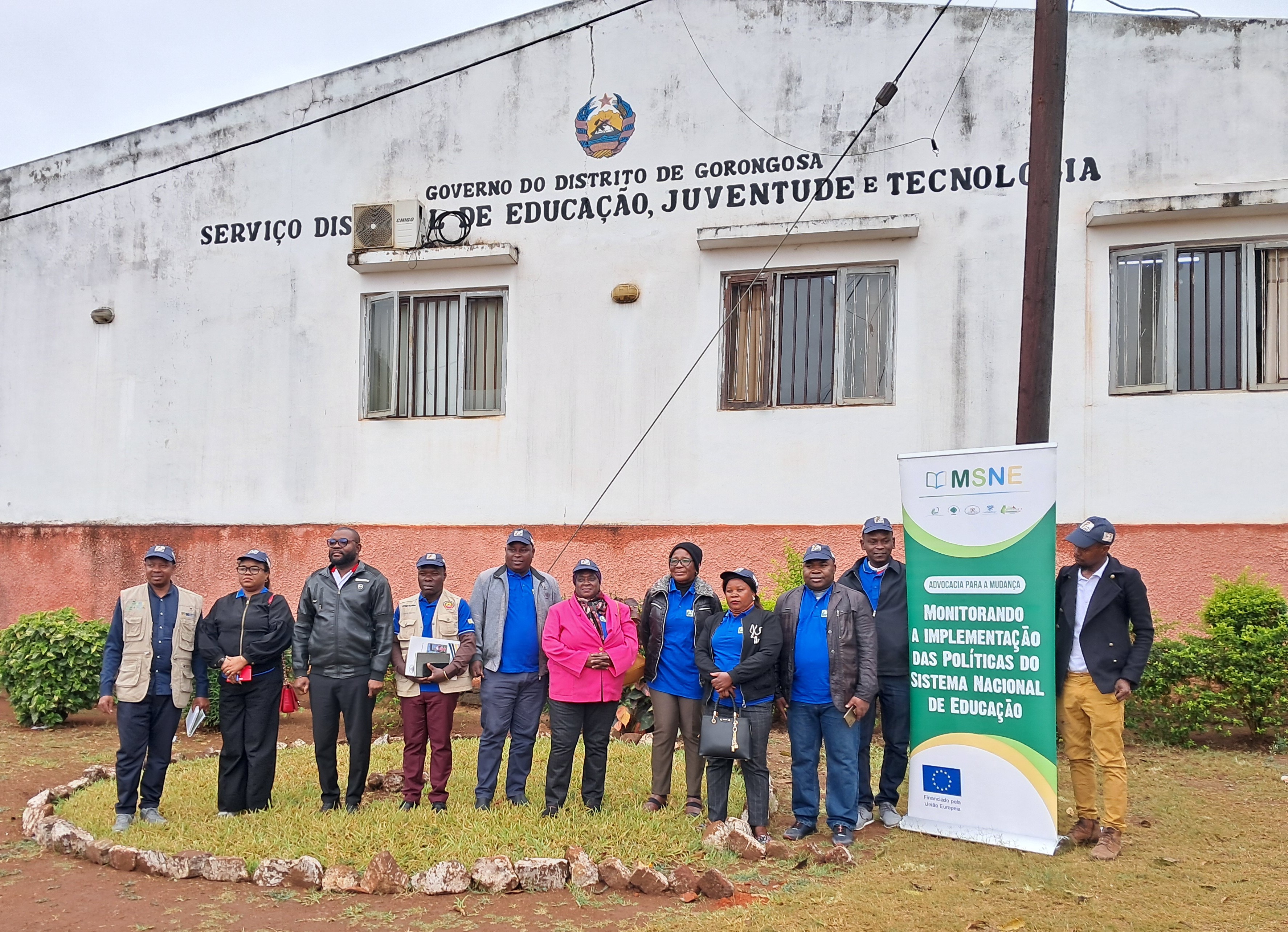
Between 11 and 14 August 2026, ASADEC and the Movement for Education for All (MEPT) travelled to Gorongosa district in Sofala province for a joint monitoring visit to School Councils. The mission is part of the MSNE project — implemented in five provinces of Mozambique and funded by the European Union — and aimed to assess how education policies, plans and programmes are being implemented in schools, strengthen participatory oversight, and promote active citizenship and a culture of peace in the school environment.
A mission with many actors
The ASADEC/MEPT technical team arrived in Gorongosa on 11 August for a preparatory meeting with SDEJT (District Services for Education, Youth and Technology). The Director, Mr. Abdul Carimo Mbonia, framed the district's context: 100 schools in total — 58 primary, 36 basic and 6 secondary — serving communities that stretch across dozens of kilometres. Over the following two days, the team was joined by Members of the 2nd and 8th Committees of the National Assembly, members of the Economic, Social and Environmental Affairs Committee of the Sofala Provincial Assembly, technicians from the Sofala Provincial Directorate of Education, and journalists — together in a joint mission rare in scale and diversity.
Schools visited — five different realities
Over two days, the team visited five schools: 16 de Junho Primary School, Eduardo Mondlane Secondary School, Nelson Mandela Secondary School, Baramanza Primary School (37 km from the district capital), and 25 de Setembro Primary School (now Nhamazi Secondary, resulting from the merger of two schools on the same site). At each school, two data-collection instruments were applied: a School Council survey and a School Management survey, covering the ADE fund (Direct Support to Schools) management, community engagement, and quality of teaching.
What we found on the ground
At 16 de Junho Primary School, we found serious governance failures: the Director personally handles purchasing (against the ADE manual), communication with staff is weak, and important documents are missing from files. Eduardo Mondlane Secondary School showed the opposite — strong cohesion between management and the Council, well-organised records. Nelson Mandela Secondary School has an engaged Director but faces night-time vandalism, has only 3 computers in its IT room, and a library lacking books; COVID-19 sanitation facilities remain closed for lack of a formal handover. In Baramanza, the situation is critical: construction started in May 2023 (5 classrooms, an administrative block, sanitation facilities, water system) remains stalled, forcing students to learn in makeshift classrooms of stakes and clay with zinc roofs 1.25 m from the doorways — there have already been cases of serious cuts to students requiring medical evacuation. Finally, 25 de Setembro School (Nhamazi) was a positive surprise: excellent school-community communication, information delivered on time, and gardens with fruit trees (lemon, orange, avocado) feeding boarding students.
Good practices identified
The visit documented good practices worth replicating: SDEJT Gorongosa carries out regular monitoring visits to schools in the district; several schools where ASADEC has run capacity-building sessions have students actively engaged on relevant issues (prevention of teenage pregnancy, early unions and alcohol use); and several School Councils show high engagement on pedagogical, financial and school-production matters.
Challenges that remain
The mission identified challenges requiring urgent intervention: construction stalled in Baramanza for over three years, with safety risks for students; COVID-19 sanitation facilities closed at several schools for lack of a formal handover; adult literacy facilitators from the Baramanza community unpaid since 2024, threatening the continuity of adult education; night-time vandalism in schools without adequate security coverage; shortages of books, computers and teaching materials; and the persistence of teenage pregnancy cases among school-age girls.
Recommendations from the review meeting
At the review meeting, led by Sofala Provincial Directorate of Education technician Mr. Vasco Mussarandoga, clear recommendations were left: the Sofala Provincial Directorate of Education must strengthen its follow-up to ensure rigorous compliance with National Education System policies; SDEJT must intensify monitoring of ADE fund use, with special attention to 16 de Junho and Baramanza schools; Members of the National and Provincial Assemblies must follow up on the COVID-19 sanitation facilities left closed in almost every district where they were built; and it is urgent to complete the works at Baramanza Primary School.
This joint visit showed that when ASADEC, MEPT, the National Assembly, the Provincial Assembly, the Sofala Provincial Directorate of Education, and SDEJT work side by side with School Councils, oversight is no longer an isolated exercise — it becomes a real instrument for change. ASADEC will continue to accompany these schools closely and to replicate this methodology in other Sofala districts, under the MSNE project — which reaches five provinces of the country with the support of the European Union.